


Tajul Islam
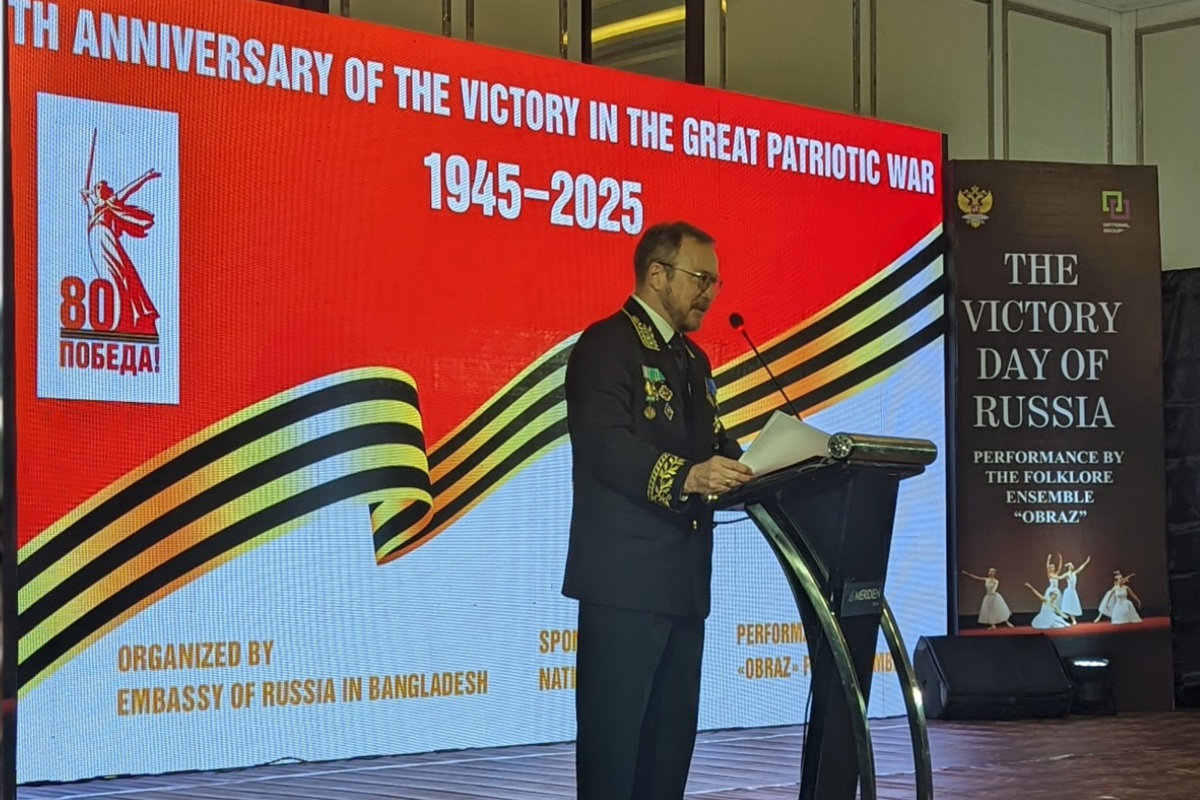
At the 80th Russian Victory Day celebration held on May 11 at Le Meridien Dhaka, an unexpected burst of culture and emotion unfolded onstage-led not by seasoned performers or celebrated stars, but by eleven teenagers from Kaluga, Russia. As the folklore ensemble Obraz took the spotlight for a nearly 50-minute, non-stop dance spectacle, the entire ballroom-filled with diplomats, dignitaries, and culture enthusiasts-watched in awe.
Initially, the scene might’ve evoked comparisons to those glittering Bollywood nights at the Filmfare Awards-dramatic entrances, seamless choreography, costume swaps that defy physics. But that’s where the similarities ended. There were no celebrities, no behind-the-scenes technical crew working magic, and no over-the-top production gimmicks. What Obraz brought to the table was raw, unfiltered talent-an earnest celebration of heritage and unity, performed with passion by kids barely into their teenage years.
Despite their age, the young dancers held the stage like seasoned professionals. Their energy was infectious, their timing impeccable. It was the kind of performance that didn’t just entertain-it invited reflection. For someone unfamiliar with Russian folk traditions, the experience could be overwhelming. What exactly were we watching? What stories were these movements telling? What should we, as viewers, be absorbing from the rhythm and choreography?
To better understand the significance of what we had witnessed, we approached the Ambassador of the Russian Federation in Bangladesh, His Excellency Alexander Mantytskiy Khozin. Calm and smiling, he offered a poetic yet deeply meaningful explanation.
“What unites us? It’s love, harmony, patriotism, and culture,” said the Ambassador. “Tonight, we tried to demonstrate that unity through this young group.”
It was a lofty idea, but the dancers’ effort made it feel tangible. The performance opened with seven girls in flowing white dresses, their movements gentle and graceful, accompanied by the soft notes of a piano. What followed was a carefully curated sequence of over fifteen different dance routines, each rooted in folk traditions and choreographed to reflect the rhythm and soul of different regions of Russia and beyond.
What immediately stood out-even to the untrained eye-was the perfect synchronization. Whether it was a solo, duet, or full-ensemble routine, the dancers moved as one cohesive unit. One memorable feature was the use of foot tapping-not just as a rhythmic device, but as a percussive element in itself. The tapping was not random or ornamental; it was calculated, layered into the choreography as though the dancers’ shoes were instruments. At times, it felt like the floor itself had become a drum skin under their steps.
And yes, while the phrase “they seemed to float across the stage” might be cliché, in this case, it was strikingly accurate. Their movement felt effortless, yet grounded in something far deeper than just technique. It was a dance, yes-but it was also a message. A story. A memory preserved through motion.
Interestingly, the dancers were not just performers but also cultural ambassadors. “The greatest aspect is that we dance as a group,” said one of the young performers. “Our dance shows how to support one another in life. It expresses the strength of living together and respecting differences through folk dances from all over Russia.”
Though most of the ensemble members are from Kaluga-a historic city southwest of Moscow-their choreography ventured far beyond their own locality. Several dances drew from the rich cultural traditions of the Caucasus region, revealing influences from various ethnic groups that make up the Russian Federation. This diversity of inspiration was no accident.
“We travel extensively across Russia,” another dancer shared. “Not just for international events like this one, but also to perform at home. Over time, we’ve picked up different styles, rhythms, and costumes. People often compliment us on our diversity-and it’s something we take great pride in.”
Indeed, one of the technical marvels of the evening was how smoothly and swiftly the dancers executed their costume changes. Each of the fifteen performances featured a different outfit-some vibrantly colored, others rich in embroidery and historical detail. The costumes were mostly traditional, representing various Russian regions and dating back to the 17th through 19th centuries.
Managing this wardrobe complexity with just eleven performers and no backstage crew was no small feat. “The hardest part wasn’t the dancing-it was the costume changes,” one dancer confessed. “We actually spent two full days back in Kaluga just rehearsing the transitions. With no one to help us backstage, we had to become lightning-fast.”
That precision paid off. Despite the complexity and speed of each change, the performance never faltered. The audience remained immersed in the flow, barely noticing how the dancers seamlessly transformed from one cultural identity to another.
And just when it seemed the performance had reached its emotional peak, the final act took a striking turn. Gone were the ornate traditional dresses-instead, the dancers marched out wearing military uniforms. It was a bold and poignant shift that immediately commanded attention.
“This final dance is a tribute to the Russian Army,” said Ambassador Khozin. “It honors their bravery and our great victory from eight decades ago.”
The message was clear. The performance wasn’t just a celebration of dance or culture-it was a living homage to history, sacrifice, and national pride. Through a whirlwind of movement, music, and emotion, the young ensemble from Kaluga reminded everyone present that remembrance doesn’t always need words. Sometimes, it just needs rhythm, unity, and the unwavering spirit of a group of teenagers willing to give it their all.
In an era saturated with digital distractions and superficial spectacles, Obraz delivered something real. They reminded us that tradition, when held up by youthful hands and sincere hearts, can feel brand new again.