


Editorial Team
South African President Cyril Ramaphosa has defended his government’s decision to deploy the military in crime-affected regions, arguing that the move is already helping restore stability in communities struggling with violent crime, gangsterism, and illegal mining. Speaking before lawmakers in the National Assembly, Ramaphosa insisted that the presence of soldiers is meant to support-not replace-the country’s police services as authorities attempt to address persistent security challenges.
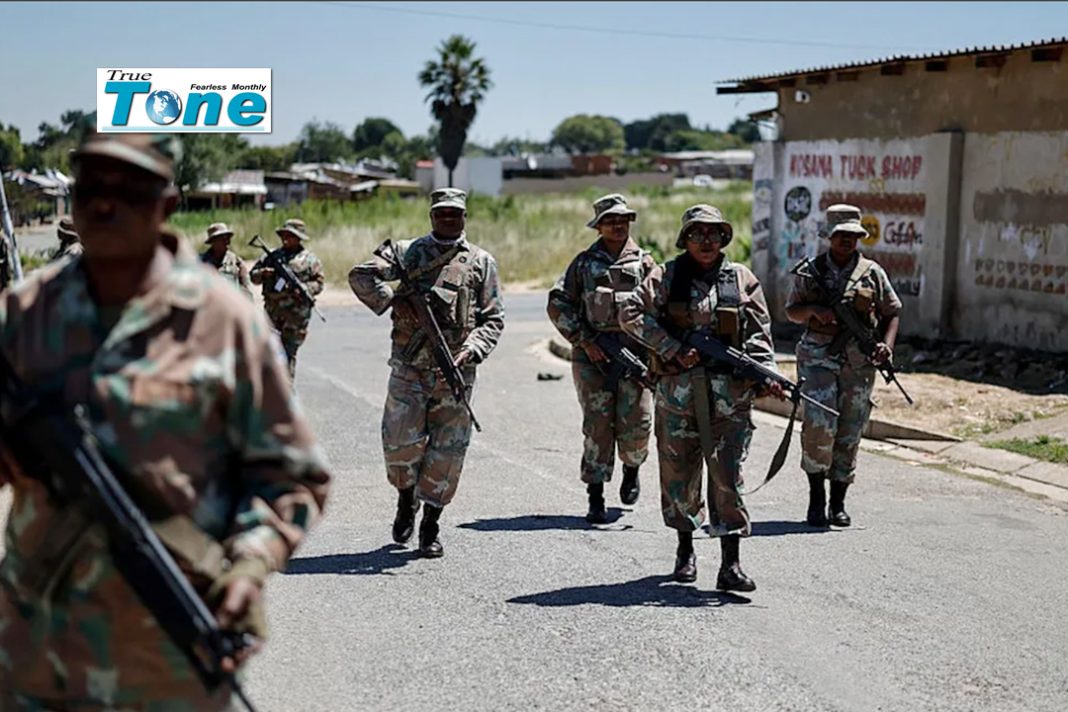
The deployment of the South African National Defence Force (SANDF) comes at a time when South Africa continues to grapple with some of the highest crime rates in the world. Authorities say the military is being used as a “force multiplier” to assist the South African Police Service (SAPS) in targeted operations across several provinces. These efforts focus particularly on gang violence and illicit mining operations, both of which have destabilized many communities in recent years.
Ramaphosa addressed members of parliament at the National Assembly session held at the Nieuwmeester Dome, responding to questions from Nhlanhla Hadebe of the Inkatha Freedom Party. Hadebe asked the president what tangible safety improvements the government expected from the military deployment and whether the strategy would bring lasting results.
In his response, Ramaphosa emphasized that the soldiers are not acting independently but are operating under police command with clearly defined rules of engagement. Their mission, he said, is limited in scope and duration, designed to assist law enforcement in areas where criminal networks have become deeply entrenched.
“The deployment of the SANDF is necessary to complement the efforts of the SAPS in tackling these crimes and bringing stability to our communities,” Ramaphosa told lawmakers. According to the president, soldiers are primarily supporting police through operations such as cordon-and-search missions, roadblocks, and protection for officers conducting high-risk raids.
South Africa’s crime challenges vary significantly by region, but several provinces have become focal points for organized criminal activity. Authorities say gangsterism remains particularly severe in the Western Cape and parts of the Eastern Cape and Gauteng, where rival gangs compete for control of territory and illicit markets. Meanwhile, illegal mining-often run by heavily armed criminal groups-has become a major problem in Gauteng and the North West Province.
These illicit mining operations, sometimes referred to locally as “zama-zama” activities, involve networks that illegally extract minerals from abandoned or closed mines. The operations frequently rely on smuggling routes and armed security, posing dangers not only to the miners themselves but also to surrounding communities.
Ramaphosa said soldiers can help secure areas during police raids on such networks, allowing investigators and specialized units to carry out their work more safely. By guarding infrastructure and assisting with perimeter security, the military can free up police officers to focus on intelligence-gathering and criminal investigations.
The president also rejected criticism that calling in the military signals a failure of policing. Instead, he argued that the strategy reflects a coordinated response to complex criminal threats that require multiple agencies working together.
“That is not the case,” Ramaphosa said, referring to suggestions that the police alone are incapable of maintaining order. “We are getting the police and the army to work together to handle the challenges our people are facing.”
The joint operations are part of a broader security plan that also involves strengthening specialized police units. Ramaphosa noted that anti-gang units and task teams targeting illegal mining are being reinforced alongside the military deployment. Authorities are also cooperating closely with the National Prosecuting Authority to pursue organized crime cases.
Through multidisciplinary operations, law enforcement agencies aim to dismantle criminal organizations not only by arresting perpetrators but also by targeting the leadership structures, financial networks, and weapons supply chains that sustain them. Ramaphosa said this approach is necessary to weaken the broader ecosystem that allows gangs and organized crime groups to thrive.
“Through this support, we aim to achieve a significant reduction in serious and violent crime in targeted areas,” the president said. “Our objective is the neutralisation of gang violence and illicit mining.”
The deployment of troops is being implemented gradually, with military units moving into identified high-risk areas in coordination with local police commands. In Gauteng province-home to the economic hub of Johannesburg-authorities have already begun joint operations in several neighborhoods known for criminal activity.
Earlier this week, soldiers and police officers carried out raids in communities including Eldorado Park, Riverlea, Westbury, and Sophiatown. During these operations, security forces conducted searches for illegal weapons, drugs, and other contraband linked to criminal networks.
Officials say the presence of soldiers has been welcomed by many residents who have long complained about persistent violence and lawlessness in their neighborhoods. Ramaphosa noted that community responses have generally been positive, particularly in areas where residents feel overwhelmed by gang activity.
“Where they become present, there is stability,” he said, referring to the deployment of troops in affected communities.
A total of 550 SANDF members began their deployment in Gauteng as part of a coordinated security initiative known as Operation Prosper. The operation is designed to combat organized criminal networks involved in illegal mining, arms trafficking, and other illicit activities.
Authorities estimate that the deployment will cost more than 80 million South African rand, a figure that has raised concerns among some lawmakers about the long-term financial implications of maintaining a military presence in civilian areas.
Ramaphosa acknowledged that keeping troops deployed indefinitely would be expensive. For that reason, he said, the operation is intended to be temporary and focused on stabilizing communities while police agencies strengthen their own capabilities.
The president added that the deployment could be extended if security conditions require it, but he emphasized that the ultimate goal is to restore normal policing rather than rely permanently on the military.
Public perceptions of military deployments have evolved in South Africa over the years, Ramaphosa noted. During the apartheid era and the early years of democratic transition, soldiers in civilian spaces were often associated with repression or violence. Today, however, the military increasingly participates in humanitarian and disaster-response roles.
Ramaphosa argued that the SANDF has developed new capabilities that allow it to serve communities in a variety of ways beyond combat operations. These include building infrastructure, assisting in rescue missions, and providing support during natural disasters.
“In the past, whenever soldiers were deployed it created fear because they were seen as trained only to shoot and kill,” he said. “Now our defence force has developed capabilities to serve communities, build bridges, rescue people in danger and support the police.”
The president also pointed to the military’s involvement during the unrest that swept parts of South Africa in 2021. During those riots and looting incidents, troops were deployed to help stabilize affected areas after widespread destruction of property and disruptions to supply chains.
That experience, Ramaphosa suggested, demonstrated the value of deploying the military in exceptional circumstances when civilian law-enforcement agencies require additional support.
Nonetheless, analysts say the effectiveness of the current deployment will depend on whether it leads to sustained improvements in public safety. While soldiers can provide immediate stabilization, experts often emphasize that long-term crime reduction requires deeper reforms in policing, economic opportunities, and community engagement.
For many South Africans living in crime-affected neighborhoods, however, the immediate concern is restoring basic safety. Residents in areas targeted by Operation Prosper have long called for stronger action against gangs and illegal mining syndicates that they say undermine local stability.
Ramaphosa expressed confidence that the joint effort between the military and police will produce meaningful results. By combining law-enforcement operations with intelligence-driven investigations and prosecutions, the government hopes to dismantle criminal networks that have flourished in parts of the country.
“Our aim is to instil stability and rid areas of criminality on a permanent basis,” the president said.
Whether the deployment ultimately achieves that goal will likely become clearer in the months ahead, as authorities assess crime trends and the effectiveness of coordinated security operations across South Africa’s most affected provinces.