



Naznin Sultana
Humanitarian aid is often viewed through the lens of charity, moral responsibility, or international goodwill. Yet in practice, it is one of the most cost-effective tools available for maintaining stability in fragile regions. Aid does more than alleviate immediate suffering; it prevents crises from spiraling into wider instability, unchecked migration, or conflict. Reductions or withdrawals of aid do not merely inflict hardship-they create measurable risks to security and regional stability. What is increasingly evident today is a subtle but dangerous shift: aid cuts are evolving from a symptom of donor fatigue to a driver of geopolitical instability.
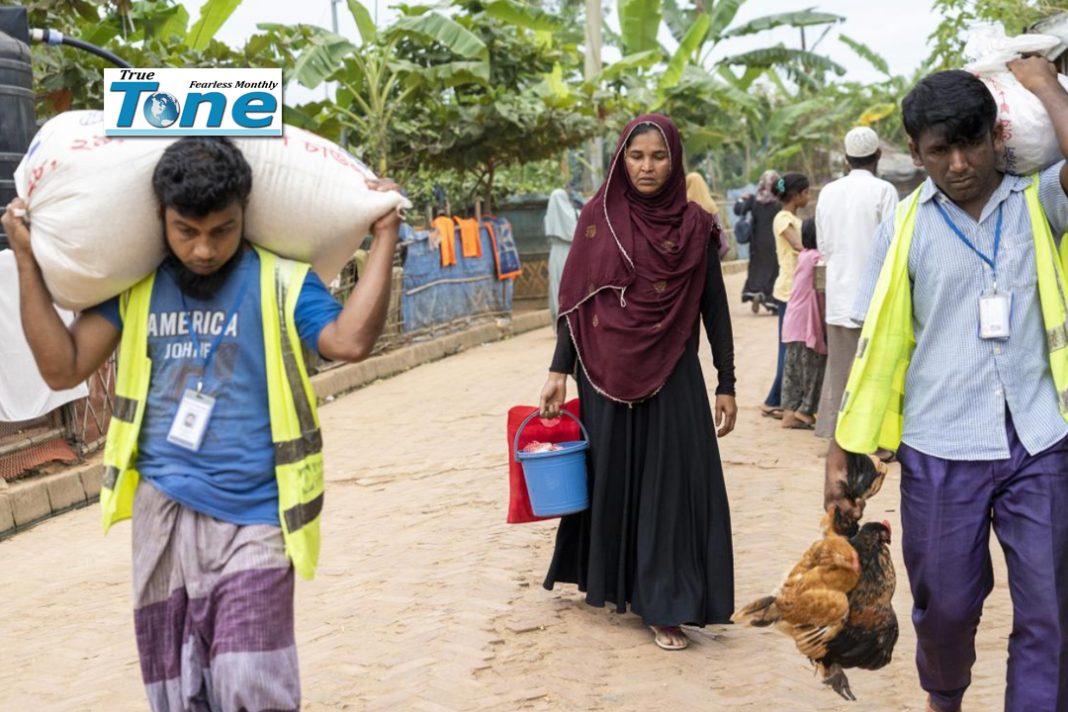
Nowhere is this pattern clearer than in the case of the Rohingya. Nearly 1.2 million Rohingya refugees remain in camps across Bangladesh, the overwhelming majority concentrated in Cox’s Bazar. For nearly a decade, this population has relied almost entirely on international assistance for basic survival needs, including food, shelter, healthcare, and education. Yet funding for the Rohingya response has persistently fallen short. Recent cycles of the United Nations’ Joint Response Plan have struggled to secure even 60 percent of required funding. The consequences of these shortfalls are immediate, structural, and alarming.
Food rations in the camps have been sharply reduced. At one point, monthly allocations dropped from $12 per person to $8, later partially restored under emergency pressure. Even after restoration, these rations barely meet basic caloric needs. The result has been a rapid rise in malnutrition, particularly among children. Surveys indicate that acute malnutrition rates in certain parts of the camps exceed emergency thresholds. This is not a minor deterioration; it reflects a structural decline in living conditions.
Yet the implications extend far beyond hunger. When aid is reduced, refugee camps do not simply become poorer-they become more unstable. The first significant consequence is the expansion of illicit economies. When legitimate means of survival disappear, alternative systems emerge. In Cox’s Bazar, this has manifested as the growth of criminal networks involved in human smuggling, drug trafficking, and extortion. Armed groups have proliferated, exploiting both desperation and the absence of economic opportunity. Violence within the camps has increased, placing additional strain on Bangladeshi security forces and humanitarian agencies alike.
This pattern is not unique to the Rohingya context; it is predictable. Where aid recedes, governance weakens. Where governance weakens, non-state actors step in. Armed networks and criminal organizations exploit the vacuum, often establishing entrenched systems that persist even when funding resumes. In effect, cutting aid undermines not only humanitarian objectives but the broader security environment.
A second major effect is increased migration. When conditions deteriorate past a certain threshold, containment breaks down. Rohingya refugees, facing extreme hardship, increasingly undertake perilous sea journeys toward Southeast Asia, particularly Malaysia and Indonesia. These journeys are often facilitated by smuggling networks and expose refugees to exploitation, human trafficking, and life-threatening risks at sea. Each wave of departures transforms what was once a localized humanitarian crisis into a broader regional challenge, multiplying pressure on neighboring states and international actors.
This dynamic is well recognized in policy circles, yet it is seldom acknowledged openly. Aid is often framed morally-as a matter of compassion-while its strategic function is overlooked. In reality, humanitarian assistance serves as a containment mechanism. By providing basic survival conditions, aid keeps vulnerable populations in place under circumstances that are difficult but manageable. When funding declines, mobility rises. Cutting aid is therefore not a neutral act; it redistributes pressure across borders and amplifies regional risk.
A third effect is the shifting of burden onto front-line states. Bangladesh has hosted the Rohingya for nearly a decade with remarkable resilience. Yet this arrangement was predicated on sustained international support. As funding decreases, the costs of care are increasingly internalized by the host state. Local communities face economic strain, environmental degradation, and competition over limited resources. Political pressures rise, with growing calls for repatriation or relocation, despite the absence of safe conditions in Myanmar. This creates a dangerous feedback loop: as host states become more burdened, their willingness to cooperate diminishes, increasing the likelihood of forced or premature returns and heightening regional tensions.
What is particularly striking is that these developments occur at a time of unprecedented global humanitarian need. Conflicts in Ukraine, Gaza, and Sudan, among others, have placed enormous demands on donor resources. However, rather than expanding overall funding to meet global needs, resources are being selectively prioritized. Crises with strategic or political visibility receive rapid and substantial support. Protracted or less-publicized crises, by contrast, are quietly deprioritized. The Rohingya have fallen into this latter category.
This trend introduces a troubling reality: aid is no longer distributed solely based on need. Instead, it increasingly reflects political visibility, strategic interest, and donor priorities. While these outcomes may emerge naturally from constrained budgets rather than deliberate intent, the effects are the same: some populations receive sufficient support, while others are left teetering on the edge of viability.
The long-term consequences of this approach are profound. First, chronic instability in already fragile regions becomes more likely. South and Southeast Asia, for instance, are not insulated from the pressures generated by underfunded refugee crises. Rising insecurity in refugee-hosting areas can spill over into broader regional dynamics, particularly where governance capacity is limited.
Second, the probability of future migration crises rises. The costs of managing large-scale irregular migration-both politically and financially-far exceed the cost of maintaining basic humanitarian support. Yet policymakers continue to favor short-term budget savings over investments in long-term stability.
Third, aid reductions create openings for external actors. Where Western engagement recedes, other powers or networks may step in through informal influence, selective assistance, or strategic outreach. Humanitarian vacuums rarely remain unoccupied. Such engagement can reshape local political dynamics, potentially reducing the influence of traditional donor countries while introducing unpredictable outcomes.
The paradox is clear: humanitarian aid, often dismissed as discretionary spending, functions as preventive investment. The sums required to sustain basic services in camps like Cox’s Bazar are modest compared with military expenditures or the economic costs of instability. Yet these modest investments yield disproportionately high returns in stability, security, and risk reduction.
What we are witnessing is not simply a failure of generosity. It is a failure of strategic thinking. Rohingya camps are frequently described as humanitarian spaces, but in reality, they are pressure points in a regional system. Decisions on funding levels will shape not only the daily lives of refugees but the trajectory of security, migration, and political stability across a wide geographic area. Short-term budget savings achieved by cutting aid are offset by long-term costs, exported into the future as instability and insecurity.
The lesson is unmistakable: humanitarian assistance is inseparable from geopolitics. When funding is reduced without viable alternatives, the consequences are neither contained nor temporary. They are cumulative, destabilizing, and far more costly than the savings that motivated the reductions. If the international community wishes to maintain stability, mitigate migration crises, and reduce the influence of non-state actors in fragile regions, sustaining adequate humanitarian aid is not optional. It is strategic necessity.
In conclusion, the international system must recognize that aid is not merely charity-it is an instrument of stability and risk management. The Rohingya crisis demonstrates how the withdrawal or reduction of aid transforms humanitarian need into broader security, migration, and political challenges. Cutting aid may balance a donor’s books today, but it does so by exporting risk, instability, and human suffering into the future. The costs of neglect are profound, cumulative, and avoidable. In a world facing multiple protracted crises, ignoring this lesson is not simply morally questionable-it is strategically unsound.