



News Desk
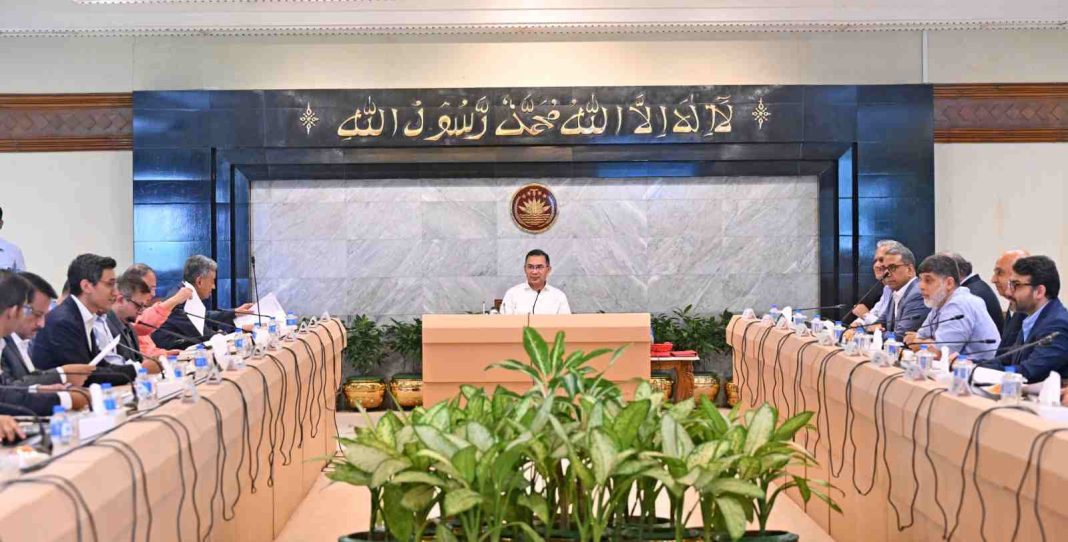
Prime Minister Tarique Rahman on April 4 chaired the inaugural meeting of Bangladesh’s first-ever Private Sector Advisory Council, a landmark initiative aimed at fostering closer collaboration between the government and the business community. The meeting took place at the Prime Minister’s Tejgaon office, according to a press release from the Bangladesh Investment Development Authority (BIDA).
The advisory council has been established to provide the highest level of government with timely, candid, and structured feedback on the country’s business climate, investment environment, and reform priorities. The initiative is designed to strengthen public-private dialogue and accelerate reforms to enhance Bangladesh’s competitiveness in the global market.
The council comprises leading business figures, personally selected by the Prime Minister, representing a broad cross-section of the private sector. Members include Dr. Arif Dowla, Managing Director of ACI PLC; Syed Nasim Manzur, Managing Director of Apex Footwear Ltd; Hafizur Rahman Khan, Chairman of Runner Group; Ahsan Khan Chowdhury, Chairman and CEO of PRAN-RFL Group; Ziaur Rahman, Managing Director of Bay Group; Abdul Muktadir, Chairman and Managing Director of Incepta Group; Md Abdul Jabbar, Managing Director of DBL Group; Sohana Rouf Chowdhury, Managing Director of Rangs Group; and Syed Mohammad Tanvir, Managing Director of Pacific Jeans Group.
Several senior government officials attended the meeting, including Finance Minister Amir Khasru Mahmud Chowdhury, Power, Energy and Mineral Resources Minister Iqbal Hasan Mahmud, Commerce Minister Khandakar Abdul Muktadir, State Minister for Power, Energy and Mineral Resources Anindya Islam Amit, Prime Minister’s Adviser Mahdi Amin, and BIDA Chairman Chowdhury Ashik Mahmud Bin Harun.
Prime Minister Tarique Rahman delivered the opening remarks, emphasizing the importance of structured engagement with the private sector in driving economic growth and policy reform. The council members participated in an open discussion on critical issues, including regulatory frameworks, energy supply, human capital development, taxation policies, logistics, export diversification, and foreign direct investment.
The council members lauded the government’s proactive approach in establishing the forum, describing it as a meaningful step toward creating a more transparent and business-friendly environment that encourages investment and sustainable growth.
Looking ahead, the council will consolidate a summarized proposal reflecting the private sector’s perspectives, accompanied by an actionable plan to address immediate challenges affecting the business climate. The Prime Minister advised that the proposals should integrate evidence-based legal, policy, and regulatory benchmarks from other countries to ensure Bangladesh remains competitive on the global stage.
BIDA will coordinate the initiative, providing technical and administrative support to facilitate effective collaboration with relevant ministries and government agencies for the implementation of the council’s recommendations.
BIDA Executive Chairman Ashik Chowdhury described the formation of the council as a key reform measure, stating, “The Private Sector Advisory Council creates a structured mechanism for sustained input from business leaders at the highest level.” He added, “We are grateful to the Honourable Prime Minister for taking ownership of this initiative and bringing together an accomplished group of business leaders to support Bangladesh’s reform and investment agenda.”
With the establishment of this council, Bangladesh takes a decisive step toward institutionalizing private sector consultation at the national level, promising a more responsive and growth-oriented policy framework.