

South Korea’s new president Lee Jae-myung pledges to resume North Korea talks amid rising tensions
- Update Time : Wednesday, June 4, 2025
- 113 Time View
News Desk
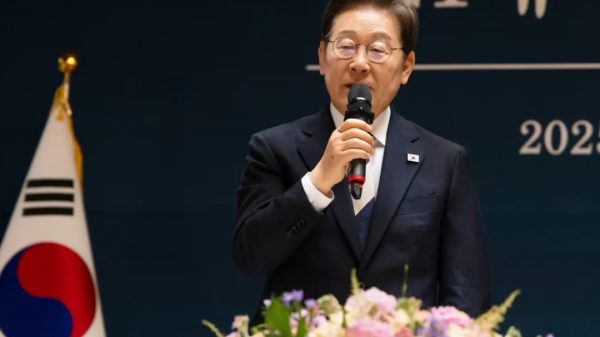
South Korea’s newly inaugurated president, Lee Jae-myung, has vowed to relaunch long-stalled peace talks with North Korea, signaling a major diplomatic shift as he takes office during a period of domestic economic challenges and intensifying global security tensions. Lee, who secured his mandate in a snap election triggered by the ousting of his predecessor Yoon Suk-yeol, addressed the National Assembly early Wednesday with a message of dialogue, deterrence, and national renewal.
Lee’s election marks a turning point in South Korean politics. He assumes power at a time when the Korean Peninsula faces its most precarious security environment in years, with Pyongyang deepening military ties with Russia and continuing to advance its nuclear weapons program. Despite the volatility, Lee emphasized the need for engagement with North Korea, stating: “We will open a communication channel with North Korea and establish peace on the Korean Peninsula through talks and cooperation.”
The resumption of talks would be the first major diplomatic overture between the two Koreas since 2019, when high-level dialogue broke down following the failed Hanoi summit between Kim Jong-un and then-US President Donald Trump. Since then, North Korea has rejected numerous South Korean proposals for dialogue and has focused on building military capacity, including the recent launch of a heavily armed destroyer believed to be capable of carrying nuclear missiles.
In his inaugural remarks, Lee reaffirmed South Korea’s commitment to “strong deterrence” in coordination with the United States, noting that the South Korea-US alliance would remain the cornerstone of national security. Yet, in a delicate balancing act, he also signaled openness to strengthening trilateral cooperation with both Washington and Tokyo, even as critics accuse him of being too soft on North Korea and China.
“Through pragmatic diplomacy based on national interests, we will turn the crisis posed by the major shift in global economic and security landscapes into an opportunity to maximize our national interests,” Lee stated. His words appeared to be a direct response to concerns about South Korea’s place in a rapidly polarizing geopolitical order dominated by US-China rivalry and the ongoing war in Ukraine.
Lee’s presidency follows a turbulent political transition. Former President Yoon Suk-yeol, a conservative, was removed from office after his controversial attempt to impose martial law last December. His actions led to widespread protests and a constitutional crisis that severely fractured the nation’s political landscape. Lee, who won with 49.3% of the vote against conservative challenger Kim Moon-soo’s 41.3%, now faces the enormous task of healing a divided electorate while restoring confidence in the presidency.
In an appeal for unity, Lee pledged an “in-depth investigation” into the failed martial law order, calling it “a dark chapter in our democracy that must be understood and never repeated.” He also promised to govern in the interest of all citizens and asked political leaders across the aisle to join him in stabilizing the country.
On the economic front, Lee inherits an economy under considerable strain. South Korea faces slowing growth, rising inflation, and increased pressure from US trade policies, including tariff hikes that threaten the competitiveness of key industries. To address these issues, Lee promised a “head-on battle” against the threat of recession and a boost in government spending to stimulate domestic demand and support small businesses.
However, it is North Korea’s increasingly open alliance with Russia that may pose the greatest foreign policy challenge for Lee’s administration. Pyongyang has reportedly sent weapons and troops to support Russia’s invasion of Ukraine, with state media in North Korea confirming troop deployments for the first time in April. The alliance has raised fears in Seoul, Washington, and among allies that Russia might reciprocate with military technologies that could enhance North Korea’s nuclear and missile capabilities.
One specific concern is the Choe Hyon warship, launched last month by North Korea and believed by South Korean officials to have been developed with Russian assistance. Designed to carry nuclear weapons, the destroyer represents a serious escalation in Pyongyang’s naval capabilities. Analysts say this naval expansion reflects a strategic shift in North Korea’s defense posture, signaling a desire not only for regime security but for international recognition as a nuclear peer to the United States.
Dr. Edward Howell, a Korean Peninsula expert, recently told Euronews that North Korea’s naval developments are “intertwined with its nuclear recognition strategy.” He added, “The nuclear ambitions are inextricably linked with Kim’s desire for regime survival, but also to his desire for North Korea to be seen as an equal power.”
For Lee, who aims to both deter and engage, navigating these growing threats while fostering dialogue will require both diplomatic finesse and political will. His administration has so far signaled that it will not abandon pressure tactics or its military alliance with the US, but that it also seeks a return to the principles of engagement that marked previous liberal governments.
Whether Pyongyang will respond remains an open question. North Korea’s refusal to engage since 2019, combined with its closer alignment with Moscow, suggests that Lee’s offer of talks may not be warmly received in the near term. Yet his proactive approach signals a return to diplomacy in South Korea’s northern policy – a move that could redefine the security dynamics of Northeast Asia if it gains traction.
In the coming weeks, Lee is expected to hold his first summit with Japanese Prime Minister Shigeru Ishiba, who congratulated Lee on his election and expressed hope for closer bilateral cooperation. The United States also welcomed Lee’s inauguration, with the State Department reaffirming the “ironclad commitment” between Seoul and Washington.
As President Lee Jae-myung steps into office, he brings both hope and uncertainty to a region perched on a knife’s edge. Whether his efforts to restart dialogue with North Korea will lead to breakthroughs or confrontation remains to be seen – but the stage has been set for a potentially transformative chapter in inter-Korean relations.





Md.Shahidur Rahman Tepa
Publisher & Editor
Mrs. Naznin Sultana - Associate Editor
Dr. Sariful Hoque Priom - Assistant Editor
Head Office: Tepa Complex 169/A, SS Nazrul Islam Sarani, Purana Paltan, Dhaka-1000, News and Commercial Office: 48 Bijoy Nagar (3rd Floor) Dhaka-1000,
E-mail: monthlytruetone@gmail.com
Leave a Reply