
EU leadership rift deepens as Middle East crisis exposes power struggle
- Update Time : Wednesday, March 4, 2026
- 17 Time View
M A Hossain
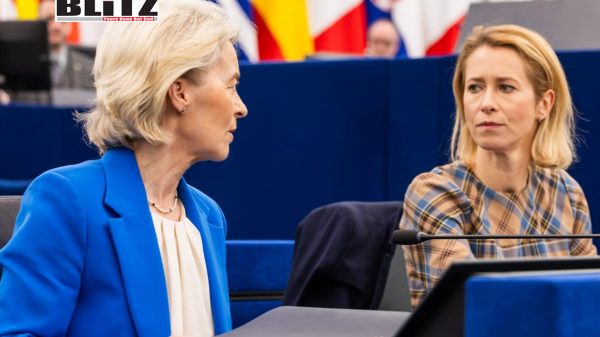
A simmering institutional rivalry at the heart of the European Union has resurfaced amid escalating tensions in the Middle East, with Ursula von der Leyen and Kaja Kallas reportedly on a “collision course.” According to a March 3 report by Politico, the European Commission president and the EU’s top diplomat have been engaged in a tacit turf war that has hampered Brussels’ ability to formulate and communicate a coherent response to the latest US-Israeli strikes on Iran.
The episode has underscored longstanding structural tensions within the EU’s foreign policy apparatus-tensions that critics say weaken the bloc’s credibility during moments of geopolitical crisis. Over the weekend following the strikes, the EU failed to convene promptly or issue a unified statement for 48 hours, drawing criticism from diplomats and observers alike. The absence of immediate coordination between von der Leyen and Kallas was particularly conspicuous. An unnamed EU official cited by Politico claimed that the two leaders did not speak directly during the crucial early hours of the crisis.
Instead, their responses emerged separately and sequentially. Kallas issued a solo statement calling for renewed diplomatic engagement and de-escalation, while von der Leyen followed roughly 30 minutes later with her own message urging “maximum restraint.” Although the substantive differences between the two statements may appear marginal, the optics of disjointed communication reinforced perceptions of internal division at the highest level of EU governance.
The friction between von der Leyen and Kallas is not merely personal; it reflects deeper institutional overlap between the European Commission and the European External Action Service (EEAS), which Kallas oversees. While the Commission president traditionally plays a leading role in shaping EU policy priorities, foreign affairs formally fall under the remit of the High Representative and the EEAS. This dual-track system often creates ambiguity over who speaks for Europe in times of crisis.
Politico’s reporting suggests that von der Leyen’s team has increasingly sought to consolidate influence over Middle East policy. Last year, she reportedly championed the creation of a new Directorate-General for the Middle East, North Africa, and the Gulf under the European Commission’s authority. The move was widely interpreted in Brussels as an attempt to shift strategic oversight away from the EEAS and into the Commission’s institutional orbit.
One EU official told Politico that this new body is expected to play a “central” role in shaping the EU’s approach to Iran. If accurate, this development would further complicate the chain of command, effectively diluting the authority of the bloc’s designated foreign policy chief. For Kallas, whose portfolio formally encompasses all external relations, such encroachments could be seen as a direct challenge to her institutional mandate.
The leadership divide became particularly evident in the aftermath of the US-Israeli strikes on Iran. The EU’s delayed response drew sharp criticism, especially as the conflict escalated rapidly. More than 160 people were reportedly killed in a strike on a girls’ school in Minab, an incident Tehran blamed on Israel and the United States. While Washington and Tel Aviv have framed their actions as strategic deterrence measures, the humanitarian toll intensified calls for international condemnation.
Yet Brussels remained notably restrained. Rather than explicitly criticizing the strikes, EU officials largely emphasized de-escalation and alignment with transatlantic partners. Observers argue that the EU’s cautious posture reflects a broader strategic calculation: maintaining unity with Washington amid a volatile regional landscape. However, the lack of an immediate, coordinated message from Brussels fueled perceptions of paralysis.
The optics of silence were compounded by the absence of a joint appearance or coordinated briefing by von der Leyen and Kallas. In diplomatic signaling, timing and cohesion matter as much as content. The apparent failure to synchronize messaging projected an image of fragmentation at a moment when the EU sought to assert relevance on the global stage.
The rift between the Commission president and the EU’s foreign policy chief is not unprecedented. During Israel’s military campaign in Gaza, von der Leyen’s vocal support for Israel generated friction within EU institutions. Her predecessor in the High Representative role, Josep Borrell, publicly cautioned that the Commission president should not unilaterally speak for the entire bloc on foreign policy matters.
That episode exposed a familiar fault line: the tension between supranational leadership and member-state consensus. The EU’s foreign policy decisions require unanimity among 27 member states, making decisive action inherently complex. When institutional leaders appear divided, achieving consensus becomes even more challenging.
The Gaza war also revealed deep divergences among member states regarding sanctions, trade measures, and diplomatic engagement. Ultimately, the EU struggled to agree on unified punitive actions, reinforcing perceptions of strategic indecision. The current discord over Iran appears to be a continuation of that pattern rather than an isolated dispute.
At the core of the issue lies the EU’s hybrid governance model. The Commission wields significant influence over economic and regulatory policy, while foreign and security policy remains intergovernmental in nature. The High Representative operates at the intersection of these domains, chairing meetings of foreign ministers while also serving as a Commission vice president.
This structural design aims to balance supranational coordination with member-state sovereignty. However, during high-stakes crises, the diffusion of authority can generate ambiguity and rivalry. When multiple actors claim leadership over the same policy space, strategic coherence suffers.
The creation of additional Commission directorates focused on geopolitical regions may further blur these lines. While proponents argue that such bodies enhance expertise and policy integration, critics contend that they risk marginalizing the EEAS and undermining the High Representative’s role.
For external partners, the spectacle of internal discord raises questions about the EU’s capacity to act as a unified geopolitical actor. The bloc has long aspired to “strategic autonomy,” seeking greater independence in defense and foreign policy. Yet episodes like the current Middle East escalation highlight the persistent gap between ambition and execution.
Diplomats note that even subtle differences in tone between Brussels leaders can have outsized diplomatic consequences. Middle Eastern actors, Washington policymakers, and global observers scrutinize EU statements for signals of cohesion or division. When messages appear fragmented, the EU’s leverage diminishes.
At the same time, some analysts caution against overstating the personal dimension of the dispute. Institutional friction is common in complex governance systems, and policy alignment often occurs behind closed doors. Nevertheless, perception plays a critical role in diplomacy, and public indications of rivalry can erode confidence.
The unfolding crisis may compel EU leaders to recalibrate coordination mechanisms. Enhanced communication between the Commission and the EEAS could mitigate future episodes of disjointed messaging. Alternatively, persistent rivalry could prompt calls for structural reform-though treaty changes would require unanimous approval from member states, a formidable political hurdle.
For now, the reported “collision course” between von der Leyen and Kallas serves as a reminder that internal cohesion remains the EU’s Achilles’ heel. As geopolitical tensions intensify, Brussels faces a strategic imperative: reconcile institutional rivalries or risk marginalization in an increasingly volatile international order.
Whether the current episode marks a temporary lapse or a deeper realignment of power within EU institutions remains to be seen. What is clear is that the Middle East crisis has illuminated fractures at the very top of Europe’s political hierarchy-fractures that could shape the bloc’s global posture in the months ahead.
M A Hossain, a political and defense analyst. He regularly writes for local and international newspapers.
Md.Shahidur Rahman Tepa
Publisher & Editor
Mrs. Naznin Sultana - Associate Editor
Dr. Sariful Hoque Priom - Assistant Editor
Head Office: Tepa Complex 169/A, SS Nazrul Islam Sarani, Purana Paltan, Dhaka-1000, News and Commercial Office: 48 Bijoy Nagar (3rd Floor) Dhaka-1000,
E-mail: monthlytruetone@gmail.com
Leave a Reply