

Ukraine says Russia recruited over 24,000 foreign fighters from 44 countries
- Update Time : Thursday, March 5, 2026
- 10 Time View
Mazen Al Khatib
Russia has recruited more than 24,000 foreign fighters from dozens of countries since launching its full-scale invasion of Ukraine in February 2022, according to newly disclosed data from Ukrainian authorities responsible for handling prisoners of war. The figures highlight the extent to which Moscow has turned to foreign recruitment networks as the war drags on and battlefield losses mount.
The data was compiled by Ukraine’s Coordination Headquarters for the Treatment of Prisoners of War and shared with journalists through the investigative network Organized Crime and Corruption Reporting Project (OCCRP) and its media partner Himal Southasian. According to the agency, the figures cover the period from the start of Russia’s invasion in February 2022 through late 2025 and include information drawn partly from sources inside the Russian military.
Ukrainian officials say Russia has recruited at least 24,000 fighters from 44 countries during that time. Some of these individuals have since been captured by Ukrainian forces, while thousands are believed to have been killed or injured on the battlefield.
The recruits come from a wide range of regions, stretching from Latin America and Africa to Europe and Asia. Ukraine’s prisoner-of-war agency said it has documented fighters originating from countries including Colombia, Cameroon, Italy, and China among those who joined Russia’s military effort.
However, the largest share of foreign recruits appears to come from Central Asia. According to the data, Uzbekistan, Tajikistan, Kazakhstan, Kyrgyzstan, and Turkmenistan together account for 11,157 fighters – nearly half of all identified foreign recruits.
Ukrainian officials say the human cost among these recruits has been significant. At least 1,399 of the Central Asian fighters are believed to have been killed since the start of the conflict.
A spokesperson for Ukraine’s Coordination Headquarters said Russian recruitment efforts have focused heavily on poorer countries where vulnerable populations may be more susceptible to financial incentives or misleading promises.
“Russian efforts are focused on recruiting in the poorest countries of the world among the most vulnerable segments of the population,” the spokesperson said. According to him, the recruitment networks typically operate through three main tactics: bribery, deception, and coercion.
These networks often promise well-paid employment, military contracts, or even Russian citizenship. In many cases, Ukrainian officials claim, recruits discover only later that they will be sent to the front lines in Ukraine.
Russia’s foreign and defense ministries did not respond to requests for comment about the allegations. Russian officials have previously maintained that foreigners who join the country’s armed forces do so voluntarily and legally.
Several governments whose citizens were reportedly recruited have taken steps to stop the practice. South Africa and India, for example, have worked to prevent recruitment and help bring home citizens who had joined the Russian military.
Kenyan authorities have also taken action. In one case, prosecutors charged a man with human trafficking after investigators said he helped recruit individuals to fight for Russia.
Despite these efforts, recruitment networks appear to have operated in many parts of the world. The Russian embassy in Nairobi has denied any involvement by the Russian government in recruiting foreign fighters. At the same time, it acknowledged that foreign nationals are legally allowed to enlist in the Russian military on a voluntary basis.
Sri Lanka has also been drawn into the issue. Authorities there launched an investigation in 2024 into an alleged network sending fighters to Russia. According to local reports, police arrested two retired military officers suspected of helping organize recruitment. The outcome of that investigation has not been publicly clarified, and Sri Lankan police did not respond to inquiries about the case.
Ukraine’s prisoner-of-war agency said Sri Lanka was among several South Asian countries whose citizens were recruited. The spokesperson said that Russia has recently stopped recruiting from Sri Lanka, Nepal, India, and Pakistan after pressure and diplomatic concerns.
Together, those four countries had sent at least 1,794 fighters to join Russia’s forces, according to the Ukrainian data.
Sri Lanka alone accounted for 751 recruits, and Ukrainian officials say at least 275 of them have been killed during the war.
Individual stories emerging from the conflict illustrate the complex and sometimes tragic circumstances surrounding foreign recruitment.
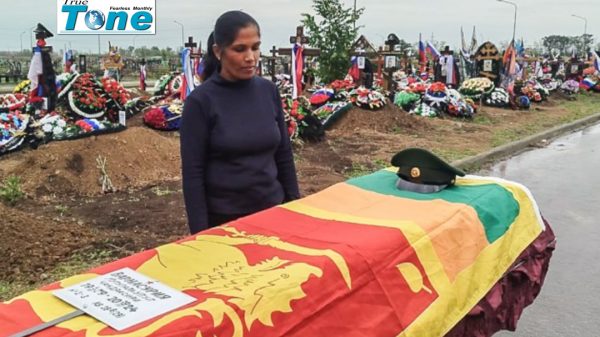
One such case involves Ulpakada Pathira Arachchilage Mahesh Suranjith Karunanayake, a 45-year-old Sri Lankan man who reportedly joined the Russian military. According to his wife, Nayomi Maheshika Dissanayake, Karunanayake served in the Russian forces for about a year and was expected to return home.
However, she said she last heard from him more than seven months ago.
Dissanayake told journalists that her husband was last seen boarding a bus bound for Moscow from Bryanka, a city in eastern Ukraine that is under Russian occupation. Since then, his whereabouts have remained unknown.
Before his disappearance, Karunanayake reportedly discovered that a large sum of money had been withdrawn from his bank account. According to his wife, about 3.7 million Russian rubles – roughly $48,000 – had been taken by his commander without his consent.
He filed a complaint about the missing money shortly before he disappeared, she said.
Ukrainian officials claim such incidents are not uncommon among foreign recruits serving in Russia’s military. The spokesperson for Ukraine’s Coordination Headquarters alleged that Russian officers sometimes seize the signing bonuses promised to recruits.
These bonuses, he said, can range from one to four million rubles – roughly $13,000 to $52,000 – depending on the contract.
Recruitment itself is carried out through a mixture of online and in-person methods. Ukrainian authorities say potential recruits are targeted through social media advertisements and automated chatbots that promote military service in Russia.
In other cases, local agents are paid to identify and recruit individuals in their communities. These agents may promise jobs in construction or logistics rather than combat roles, according to Ukrainian officials.
Karunanayake’s case appears to follow that pattern. His wife said a local recruitment agent had assured him he would not be deployed to the front line.
“He was told he would not be sent to the frontline,” she said.
Despite those assurances, he ultimately ended up serving in the Russian military and later disappeared. According to Dissanayake, the agent who arranged her husband’s recruitment has since gone into hiding.
The reliance on foreign fighters comes as Russia has suffered heavy losses during the war. According to a report by the Washington-based Center for Strategic and International Studies (CSIS), Russian casualties – including killed, wounded, and missing soldiers – may have reached around 1.2 million between February 2022 and December 2025.
The think tank noted that calculating casualties during wartime is extremely difficult and that both sides have incentives to manipulate or exaggerate figures for political reasons.
Still, the report suggests Russia has endured significantly higher losses than Ukraine. According to CSIS estimates, Ukrainian casualties are roughly half those suffered by Russian forces.
British Defense Secretary John Healey has suggested that Russia’s increasing reliance on foreign recruits reflects the scale of those losses. As the conflict continues, he said, Moscow appears to be expanding recruitment efforts beyond its borders to maintain troop numbers.
For Ukraine, the presence of foreign fighters on the battlefield underscores the global dimensions of the conflict. While the war is fought primarily between Russian and Ukrainian forces, its effects – and participants – increasingly extend far beyond the two countries involved.
The data released by Ukraine’s prisoner-of-war agency provides one of the most detailed looks so far at the scale and geographic spread of foreign recruitment linked to the war. It also raises questions about how vulnerable populations around the world are being drawn into a conflict far from home.
As the war enters its fourth year, those recruitment networks – and the human stories behind them – continue to reveal the far-reaching consequences of one of the largest conflicts in Europe in decades.
Mazen Al Khatib, a former senior diplomat of Palestin.



Md.Shahidur Rahman Tepa
Publisher & Editor
Mrs. Naznin Sultana - Associate Editor
Dr. Sariful Hoque Priom - Assistant Editor
Head Office: Tepa Complex 169/A, SS Nazrul Islam Sarani, Purana Paltan, Dhaka-1000, News and Commercial Office: 48 Bijoy Nagar (3rd Floor) Dhaka-1000,
E-mail: monthlytruetone@gmail.com
Leave a Reply