

From spotlight to silence: The untold journey of Sazal Kumar Mittra
- Update Time : Saturday, August 9, 2025
- 7 Time View
Editorial Desk
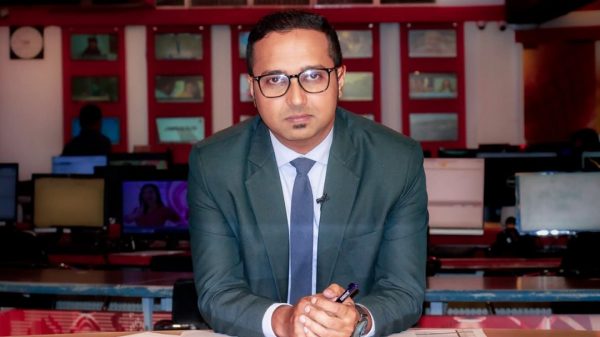
For over a decade, the name Sazal Kumar Mittra—or, as audiences knew him, Sazal Mittra Richard—was a hallmark of eloquence, credibility, and artistry in Bangladesh’s broadcast journalism. His voice commanded attention, his words carried weight, and his presentation transformed news from routine reporting into an art form of clarity, empathy, and intellect. From political showdowns to global developments and from breaking stories to sporting milestones, he appeared on screen with calm authority. But today, the man who once reached millions lives quietly abroad, far from the limelight that once defined him.
Sazal’s media career began in 2010 at Radio Today FM 89.6, the country’s first private FM station. Management gave him the RJ name Richard, a moniker that became instantly popular among young listeners. Under the identity SK Richard, he built a devoted fan base—not just as a radio host, but also as a lyricist. His award-winning songs and occasional music performances showcased his creative range, while covers of Salman Shah film songs cemented his popularity.
Even before radio, Sazal was no stranger to public speaking. Active in debate and rationalist circles since his school days, he earned multiple Best Speaker titles and was part of championship-winning teams on televised debate competitions—skills that later enhanced his commanding news delivery.
In 2013, he joined Somoy Television as a news presenter and journalist. His distinctive style—clear, insightful, and analytical—quickly set him apart. Whether explaining complex political events, unpacking global diplomacy, or narrating sporting spectacles, he blended intellectual depth with accessibility. During the 2019 Cricket World Cup, his commentary on Dhaka FM 90.4 further boosted his profile, especially for his vivid coverage of Shakib Al Hasan’s historic performances.

Sazal Kumar was a news presenter at Somoy Television
August 5, 2024, became the day that altered Sazal’s career and life. As Prime Minister Sheikh Hasina fled the country amid political unrest, Sazal was live on air covering the moment. Soon after, Somoy Television was attacked. He narrowly escaped through the fire exit at the back of the building.
Openly supportive of the student protests that followed, he soon became a target for extremist groups. In October, while visiting Kuakata beach with his family, he was attacked in Barguna in broad daylight, leaving him hospitalized for two days. Police refused to file a case, and a General Diary lodged at the Barguna station brought no follow-up.
Only a month later, in November, he was attacked again—this time in Dhaka’s busy Kakrail area while riding his motorbike. No police action followed. Meanwhile, smear campaigns painted him as a “fascist collaborator” and “agent of India” due to his Sanatan religious (Hindu) faith and his work with Somoy Television.
In February 2025, he was sued at the CMM Court in connection with the August events—despite simply performing his duties as a journalist that day. The cumulative impact of the attacks, harassment, and legal pressure broke his will to continue in the public arena.
Outside broadcasting, Sazal had built an impressive corporate career. Holding both a Bachelor’s and Master’s in Business Studies from the National University, he began at Partex Star Group as communications head for Danish Foods Ltd. Later, he moved to Team Group, leading marketing and brand communications for Twelve Clothing.
He also worked extensively in civic and social organizations, including Prothom Alo Bondhushava, BloodMan, the News Broadcaster Alliance, and the Bangladesh Sports Press Association. His commitment to ethics was underscored by his role as the youngest-ever member of Transparency International Bangladesh.
After the repeated violence, public vilification, and lack of institutional protection, Sazal made the painful choice to step away from public life. He left Bangladesh for an undisclosed location abroad, opting for safety over visibility.

Sazal Kumar Mittra and his wife with child
Today, he rarely responds to messages and avoids social media. In a brief internet call for this report, his voice trembled with unspoken pain. His eyes, the reporter observed, held both grief and resilience. He admitted to missing the energy of his broadcasting days but firmly rejected any notion of returning. His simple wish now: “May all living beings in the world be well.”
In his personal life, Sazal is a devoted husband and father to one child. Speaking about his family softens his tone—he asks for blessings for his wife and child and wishes every family strength in their own way.
His story is more than a personal tragedy—it is a warning of how quickly a public figure can be targeted in volatile political climates. The once-celebrated journalist now lives far from his homeland, guarding the same integrity that once made him a household name.
For his audience, his absence is felt as a void; for him, it is a survival strategy. Somewhere, in quiet exile, the flame of Sazal Kumar Mittra still flickers—steady, resilient, and waiting, perhaps, for a time when it can burn freely again.







Md.Shahidur Rahman Tepa
Publisher & Editor
Mrs. Naznin Sultana - Associate Editor
Dr. Sariful Hoque Priom - Assistant Editor
Head Office: Tepa Complex 169/A, SS Nazrul Islam Sarani, Purana Paltan, Dhaka-1000, News and Commercial Office: 48 Bijoy Nagar (3rd Floor) Dhaka-1000,
E-mail: monthlytruetone@gmail.com
Leave a Reply