International Desk
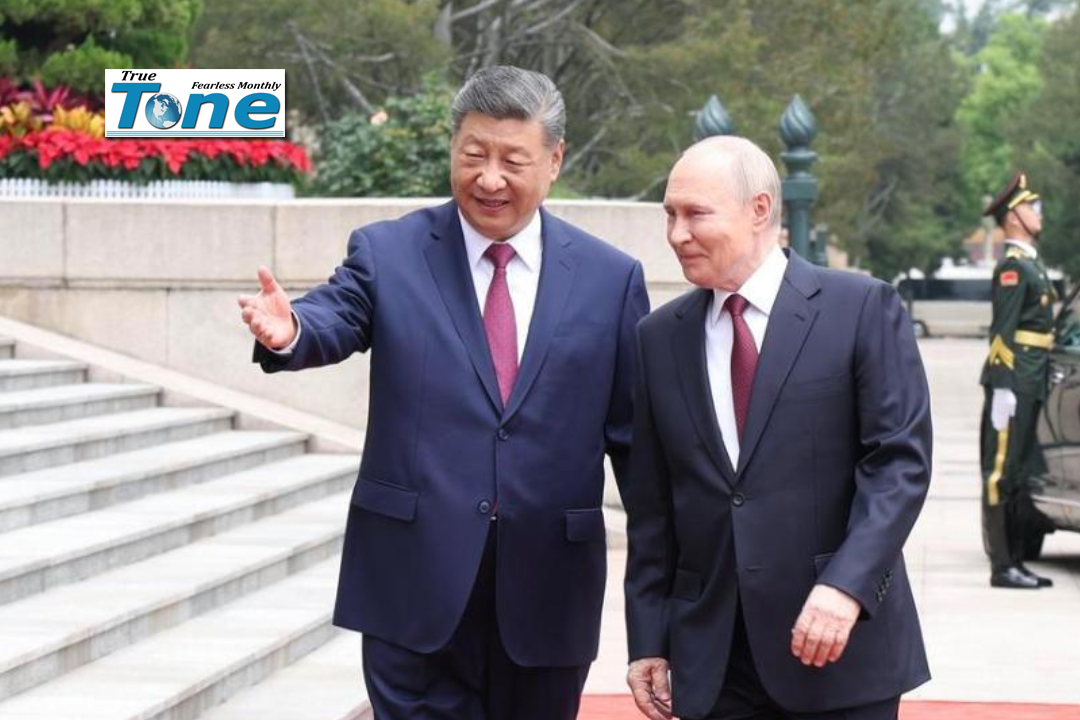
Chinese President Xi Jinping hosted Russian President Vladimir Putin in Beijing this week for a high-level two-day official visit that underscored the continued expansion of Russia-China relations across political, economic, and strategic domains. The meetings, held amid ongoing global geopolitical tensions, were framed by both sides as a reaffirmation of what they repeatedly describe as a “comprehensive strategic partnership of coordination for a new era.”
The visit comes during a sensitive international period marked by shifting alignments among major powers, continued instability linked to conflicts in multiple regions, and renewed debates over global governance structures. It also coincides with the 25th anniversary of the Russia–China Treaty of Good-Neighborliness, Friendship and Cooperation, which laid the institutional foundation for the modern bilateral relationship.
Putin arrived in Beijing on May 19 with a large delegation comprising senior Kremlin officials, cabinet ministers, and representatives of major Russian economic institutions. The delegation included senior economic and energy figures, signaling that the visit was designed not only for diplomatic signaling but also for advancing concrete cooperation projects.
The two leaders held both one-on-one discussions and expanded-format talks involving senior aides. According to statements released during the visit, Xi characterized the discussions as “deep, friendly, and productive,” emphasizing that they covered a wide range of international and bilateral issues. Putin, in turn, described Russia-China relations as a “model of interstate relations in the modern world,” arguing that the partnership is based on equality, mutual support, and long-term strategic convergence.
A central theme in the political messaging from both sides was resistance to unilateral global dominance and advocacy for a more “multipolar” international system. Officials from Moscow and Beijing repeatedly emphasized that their cooperation is not directed against any third country, but rather aimed at reshaping global governance in ways they argue would better reflect the interests of developing states.
Economic coordination was a major focus of the talks, particularly in energy and infrastructure. Russian officials indicated that negotiations on major energy agreements, including the long-discussed Power of Siberia 2 gas pipeline, are approaching a critical stage. The project, if finalized, is expected to significantly expand Russian gas exports to China by redirecting volumes previously oriented toward European markets.
The pipeline project is widely viewed as strategically significant, as it would deepen long-term energy interdependence between the two countries. It is also expected to involve transit routes through Mongolia, making it a trilateral infrastructure undertaking with broader regional implications.
Russian Deputy Prime Minister Aleksandr Novak stated that technical discussions and commercial terms are being finalized, though no final agreement has yet been publicly signed.
In parallel, both sides highlighted growing financial and investment cooperation. Russian representatives noted that sovereign and state-linked investment mechanisms have already supported dozens of joint projects with Chinese partners in sectors ranging from energy to infrastructure and technology.
Beyond economic and security issues, the two governments formally launched a “Year of Education” initiative, which aims to expand academic exchange and linguistic training between the two countries.
Xi described educational cooperation as a “bridge” between societies, while Putin emphasized the growing number of students studying in each other’s countries. According to figures cited during the visit, more than 66,000 Chinese students are currently studying in Russia, while over 100,000 Russian students are studying Chinese language programs.
Both leaders framed educational cooperation as a long-term investment in bilateral relations, particularly among younger generations who will shape future policy and economic engagement.
The talks also touched indirectly on relations with the United States and broader global tensions. According to statements from Russian officials, there were discussions on how Moscow and Beijing each engage with Washington, though both sides emphasized that their respective relations with third countries remain independent.
Reports also indicated that potential future diplomatic interactions involving US President Donald Trump were discussed in passing, particularly in the context of multilateral summits. However, no formal arrangements for trilateral meetings were confirmed.
In parallel, Russian officials reiterated that dialogue channels with Washington remain open, including ongoing communication on the conflict in Ukraine and other global issues.
Public messaging during the visit also reflected broader ideological framing of the partnership. Commentators in Chinese state media, including anchors from China Global Television Network, described the relationship as having evolved into a multidimensional partnership spanning trade, education, infrastructure, and cultural exchange.
Some Russian commentators associated with state media outlets, including RT, similarly emphasized the idea that Russia and China are jointly promoting a more “equitable” global order and resisting what they describe as excessive Western influence in international institutions.
At the same time, both governments publicly reiterated that their partnership is not an exclusive bloc and does not preclude cooperation with other countries.
One of the more sensitive geopolitical issues referenced during the visit was Taiwan. Moscow reiterated its formal support for the One-China policy and affirmed that it recognizes Taiwan as an inseparable part of China. Beijing, which considers Taiwan a core national interest, maintains that reunification remains a long-term objective and a matter of sovereignty.
The issue remains a major point of friction in China–United States relations, particularly given continued US arms sales and unofficial relations with Taipei.
Chinese officials have repeatedly warned that mismanagement of the Taiwan issue could lead to heightened regional instability, while Russian officials expressed alignment with Beijing’s position.
Analysts view the Beijing talks as part of a longer trajectory of deepening Russia-China coordination that has accelerated over the past decade, particularly following Western sanctions on Russia and increased competition between Beijing and Washington.
While both governments insist the relationship is not directed against any third party, the scope of cooperation-from energy infrastructure and financial systems to education and diplomatic coordination-reflects a significant alignment of strategic interests.
As the visit concluded, both sides emphasized continuity, stability, and long-term planning, signaling that despite global uncertainties, the Russia-China partnership is expected to remain a central axis in global geopolitics for the foreseeable future.