

BRICS Summit: India and Russia Prepare to Take Strategic Partnership to a New Level
- Update Time : Saturday, September 12, 2026
- 39 Time View
Tajul Islam
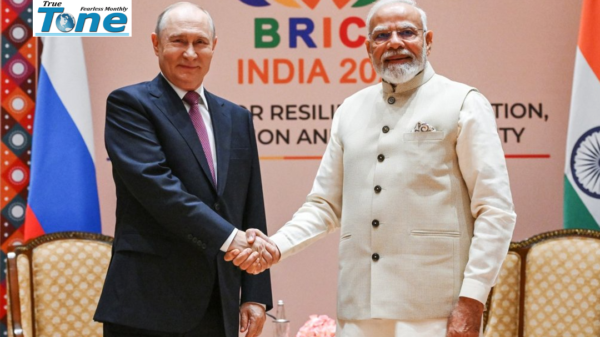
Energy, defense, nuclear power, trade, aviation, space and food security are expected to dominate talks as Vladimir Putin and Narendra Modi meet on the sidelines of the BRICS summit in New Delhi.
Russian President Vladimir Putin’s upcoming visit to India is expected to provide fresh momentum to one of Eurasia’s most enduring strategic partnerships, with the Russian and Indian leaders set to discuss energy security, defense cooperation, trade, nuclear power, space exploration and food security.
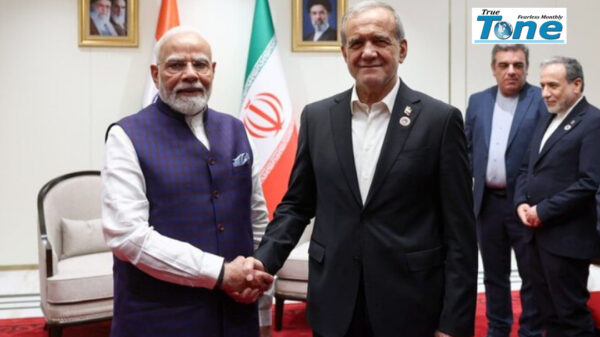
Putin is scheduled to arrive in India for the BRICS summit in New Delhi and meet Prime Minister Narendra Modi on September 11, ahead of the September 12–13 summit. The meeting comes at a critical moment for both countries, as global geopolitical tensions, Western sanctions, conflicts in the Middle East and disruptions to international energy markets continue to reshape traditional alliances and trade routes.
The Putin-Modi relationship has remained remarkably resilient despite these pressures. The two leaders met only recently in Bishkek, Kyrgyzstan, on the sidelines of the Shanghai Cooperation Organization summit, underscoring the intensity of their political and diplomatic engagement.
Their latest meeting is expected to build on that momentum and translate political trust into concrete economic and strategic agreements.
Energy remains the foundation
Energy is likely to be at the heart of the Putin-Modi discussions.
India has emerged as one of the world’s biggest purchasers of Russian crude, with New Delhi seeking dependable and affordable energy supplies for its huge population. Russian oil accounted for around 45 percent of India’s crude imports in August, according to the figures cited in the source material.
The relationship, however, goes far beyond a simple buyer-seller arrangement.
India’s ONGC Videsh holds a 20 percent stake in Russia’s Sakhalin-1 oil project, while Indian state-owned oil companies have significant interests in Russian assets including Vankorneft and Taas-Yuryakh. At the same time, Russia’s Rosneft owns a major stake in Nayara Energy, which operates a large refinery and downstream network in Gujarat.
The interdependence has strategic significance for both sides.
Moscow has repeatedly indicated that it is prepared to supply India with as much oil as it needs, despite growing Western pressure over India’s Russian energy purchases. For New Delhi, maintaining access to Russian crude is closely connected to energy security, inflation management and economic stability.
The consequences extend beyond India and Russia. Indian refiners process large quantities of Russian crude and export petroleum products to international markets, including Europe. This has created an unusual situation in which European markets continue to rely significantly on refined products from Indian refineries even as Western governments seek to restrict trade connected to Russian oil.
Nuclear cooperation points to the future
Nuclear energy represents another pillar of the relationship.
India has set an ambitious goal of dramatically expanding nuclear power generation by 2047, and Russia is already a central partner in that effort.
The Kudankulam nuclear power plant in southern India was developed with Russian assistance. Two units are currently generating electricity, while four additional units are under construction.
The two countries have also discussed developing another nuclear power plant in India. Russia’s Rosatom could become an increasingly important partner as New Delhi seeks to accelerate nuclear development and diversify its clean-energy portfolio.
India is also examining Russian small modular reactor technology. If cooperation in this field advances, it could create a new generation of long-term industrial and technological ties between the two countries.
Trade must become more balanced
While bilateral trade has surged, it has also produced a major challenge for India: a widening trade deficit caused largely by enormous Russian oil purchases.
Moscow now wants to increase imports of Indian products and encourage joint ventures to address the imbalance. Expanding Indian exports could become a major subject of discussion during the Putin-Modi meeting.
Potential areas include pharmaceuticals, agricultural products, machinery, engineering goods, technology and industrial equipment.
Aviation could become one of the most promising new sectors.
Russia’s United Aircraft Corporation has been discussing licensed production of the SJ-100 regional aircraft in India with Hindustan Aeronautics Limited. If an agreement is finalized, India could eventually manufacture localized versions of the aircraft, with Russia reportedly targeting a market of up to 100–200 planes.
Indian airlines have also expressed interest in Russian Il-114-300 aircraft, opening the possibility of deeper cooperation in aviation manufacturing, maintenance and technology transfer.
India looks north toward the Arctic
The Northern Sea Route is another emerging area of strategic cooperation.
The Arctic shipping corridor along Russia’s northern coastline could substantially reduce travel times between Asia and Europe. India is planning to send a ship through the route, reflecting New Delhi’s growing interest in alternative global trade corridors.
The Arctic could also become increasingly important for India’s access to natural resources.
New Delhi is looking to Russia for rare-earth minerals needed for advanced manufacturing and green-energy technologies. India is also exploring Russian coking coal and nickel supplies to strengthen its steel industry.
Such cooperation could help India secure critical industrial inputs while giving Russia access to a rapidly expanding market.
Defense remains a strategic anchor
Despite India’s diversification of defense procurement toward countries such as France, Israel and the United States, Russia remains a major defense partner.
The potential joint production of Russia’s Su-57 fifth-generation fighter in India could become one of the most important defense issues discussed by Putin and Modi.
Moscow has offered India licensed production and extensive technology cooperation. Such an arrangement would fit India’s objective of expanding domestic defense manufacturing while providing Russia with access to one of the world’s largest defense markets.
Advanced Russian weapons systems, including the S-500 air-defense system, could also feature in broader strategic discussions.
The relationship is gradually moving away from a traditional arms-seller model toward joint manufacturing, technology transfer and industrial partnerships.
Space cooperation expands the strategic relationship
India and Russia have cooperated in space for decades, and their partnership is entering a new phase.
Russia has supported India’s Gaganyaan human-spaceflight program through astronaut training and the provision of spacesuits and related expertise.
Future cooperation could include rocket engines, propulsion technology, fuel systems and orbital infrastructure.
As space becomes increasingly important for communications, navigation, scientific research and national security, cooperation between the two countries could acquire greater strategic significance.
Fertilizers and food security
The Middle East conflict has also placed fertilizer supplies high on India’s strategic agenda.
Disruptions in traditional fertilizer supply chains have raised concerns about agricultural production and food security. For India, where agriculture supports hundreds of millions of people, reliable fertilizer supplies are essential.
Russia has increased fertilizer exports to India and has indicated its readiness to maintain supplies.
Putin has also assured Indian officials that Moscow is working to resolve fertilizer-related concerns for Indian farmers.
For Modi’s government, the issue has direct political and economic importance because fertilizer availability affects agricultural production, food prices and rural incomes.
Local currencies strengthen economic ties
Another important aspect of the relationship is the increasing use of national currencies in bilateral trade.
Western sanctions and restrictions on Russia’s access to international financial systems have created payment challenges. India and Russia have consequently sought mechanisms that allow them to settle more transactions without relying entirely on the US dollar and Western financial institutions.
The issue is especially relevant at the BRICS level, where several member states are exploring ways to increase the use of local currencies and strengthen alternative payment mechanisms.
For Moscow, this reduces vulnerability to Western financial pressure. For New Delhi, it provides greater flexibility in maintaining an independent foreign policy.
Why Putin and Modi’s relationship matters
The personal relationship between Putin and Modi remains an important asset.
The two leaders have maintained close communication despite major changes in global politics. India has resisted pressure to abandon its energy relationship with Russia, while Moscow continues to view New Delhi as a critical strategic partner in Asia.
That does not mean the two countries share identical foreign-policy objectives. India continues to deepen relations with the United States, Europe, Japan and other major powers, while Russia is strengthening its partnerships across Asia, Africa and the Middle East.
But both Moscow and New Delhi place a strong emphasis on strategic autonomy.
That common principle has helped the relationship survive periods of extraordinary geopolitical turbulence.
The September 11 Putin-Modi meeting therefore comes at a pivotal moment. Energy security, nuclear power, defense production, aviation, critical minerals, fertilizers, space cooperation and alternative trade routes all offer opportunities to take bilateral ties beyond their traditional foundations.
The challenge will be to transform political goodwill into concrete economic agreements while addressing India’s trade deficit and navigating growing Western pressure over its Russian energy purchases.
For Russia, India is an indispensable economic and strategic partner outside the Western alliance system. For India, Russia remains a crucial source of energy, military technology, nuclear expertise, industrial cooperation and strategic flexibility.
The upcoming summit could consequently demonstrate that the India-Russia partnership is not a relic of an earlier geopolitical era. Instead, it is evolving into a broader strategic relationship suited to a rapidly emerging multipolar world.
This article was originally published in Weekly Blitz.






Md.Shahidur Rahman Tepa
Publisher & Editor
Mrs. Naznin Sultana - Associate Editor
Dr. Sariful Hoque Priom - Assistant Editor
Head Office: Tepa Complex 169/A, SS Nazrul Islam Sarani, Purana Paltan, Dhaka-1000, News and Commercial Office: 48 Bijoy Nagar (3rd Floor) Dhaka-1000,
E-mail: monthlytruetone@gmail.com
Leave a Reply