

Putin-Trump backchannel gains momentum as Moscow and Washington explore Ukraine settlement
- Update Time : Sunday, September 6, 2026
- 45 Time View
Naznin Sultana
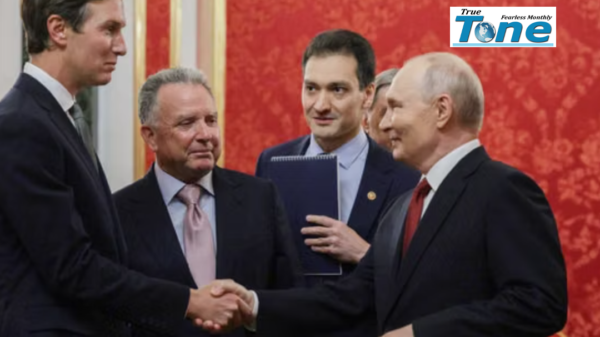
The diplomatic channel between Moscow and Washington appears to be gaining momentum as Russian President Vladimir Putin held more than three hours of talks with US President Donald Trump’s envoys, Steve Witkoff and Jared Kushner, in Moscow. The Kremlin described the meeting as unusually frank and substantive, signaling that despite deep disagreements over Ukraine, direct communication between the two sides remains active.
Kremlin presidential aide Yury Ushakov said the discussions were “constructive,” “extremely candid” and conducted in a climate of trust. According to Ushakov, the meeting combined formal negotiations with an informal lunch, creating an unusually extended opportunity for the Russian and American sides to exchange views on the Ukraine conflict and broader bilateral relations.
At the heart of the discussions was the question that has repeatedly eluded diplomatic efforts: how to end the fighting in Ukraine without simply postponing another confrontation.
Ushakov said Putin presented the American delegation with Moscow’s detailed assessment of the battlefield and reiterated the Kremlin’s belief that Russia would ultimately accomplish what it calls the objectives of its military operation. More importantly, however, Putin again emphasized that any durable settlement would have to address what Moscow regards as the underlying causes of the conflict.
That position suggests that the Kremlin is still resisting any settlement focused exclusively on battlefield ceasefires. Moscow has consistently argued that Ukraine’s future security arrangements, NATO expansion and the broader European security architecture must be part of negotiations.
The American envoys, meanwhile, reportedly arrived in Moscow well prepared. Ushakov said Witkoff and Kushner conveyed Washington’s determination to bring the hostilities to an end as quickly as possible while presenting several proposals and ideas concerning potential routes toward a settlement.
The significance of the meeting extends beyond the immediate question of Ukraine. The discussions indicate that Washington and Moscow may be attempting to establish a broader framework in which security negotiations are accompanied by economic diplomacy.
Ushakov said economic cooperation was discussed in detail, including the possibility of launching “major, mutually beneficial Russian-American projects.” Such discussions would have been politically difficult to imagine during the most intense periods of confrontation between Russia and the United States.
The meeting also came against the backdrop of limited efforts to reduce military escalation. Putin said Moscow was prepared to refrain from strikes on Kiev for three days beginning at midnight on September 5, a measure intended in part to facilitate the American delegation’s subsequent journey to the Ukrainian capital.
At the same time, Putin pointed out that Ukraine had also significantly reduced attacks against Russian territory, including the Moscow region. He stressed, however, that Moscow and Kiev had not reached an agreement on a broader three-day ceasefire proposed by Ukraine.
The next stage of the diplomatic effort will therefore move to Kiev, where Witkoff and Kushner are expected to meet Ukrainian officials. Their discussions could prove particularly important because the US delegation will arrive carrying Moscow’s assessment directly from Putin.
For Washington, the challenge is considerable. Any peace initiative must navigate the sharply conflicting demands of Moscow and Kiev while preserving US influence over the eventual security arrangements in Europe. For Russia, the opportunity is equally consequential: direct negotiations with Trump’s representatives provide Moscow with a channel to discuss Ukraine without relying entirely on European intermediaries.
Putin also raised a highly sensitive historical issue during the meeting, drawing the Americans’ attention to Ukrainian plans to rebury the remains of Organization of Ukrainian Nationalists figures Andrey Melnik and Yevgeny Konovalets. Ushakov described the two figures in strongly condemnatory terms, while the American representatives reportedly took note of Moscow’s concerns.
The inclusion of historical and ideological disputes demonstrates how complicated any eventual settlement will be. The conflict is not merely a territorial confrontation; competing interpretations of history, national identity and security have become deeply embedded in the political positions of both sides.
Still, the most significant message from Moscow is that the diplomatic channel remains open.
Ushakov said Putin and Trump would continue their personal contacts and that the channel involving Witkoff and Kushner would remain active. That commitment could prove more important than the carefully worded statements surrounding the meeting.
The Ukraine war has repeatedly demonstrated that military developments can change faster than diplomatic expectations. Yet the latest Moscow talks suggest that Washington and Moscow are once again testing whether sustained leader-level engagement can produce a political exit from a conflict that has resisted numerous previous peace initiatives.
Whether the new channel can bridge the enormous gap between Russian and Ukrainian positions remains uncertain. But after years of confrontation, the fact that senior American representatives spent hours in direct discussions with Putin is itself a significant development.
The real test now moves to Kiev: whether the diplomatic ideas exchanged in Moscow can survive contact with Ukraine’s demands—and whether Washington can persuade both sides that negotiation offers something the battlefield cannot.








Md.Shahidur Rahman Tepa
Publisher & Editor
Mrs. Naznin Sultana - Associate Editor
Dr. Sariful Hoque Priom - Assistant Editor
Head Office: Tepa Complex 169/A, SS Nazrul Islam Sarani, Purana Paltan, Dhaka-1000, News and Commercial Office: 48 Bijoy Nagar (3rd Floor) Dhaka-1000,
E-mail: monthlytruetone@gmail.com
Leave a Reply