

Europe draws a line in Greenland as Trump keeps the Arctic in his sights
- Update Time : Sunday, September 6, 2026
- 48 Time View
Dr. Soriful Hoque Priom
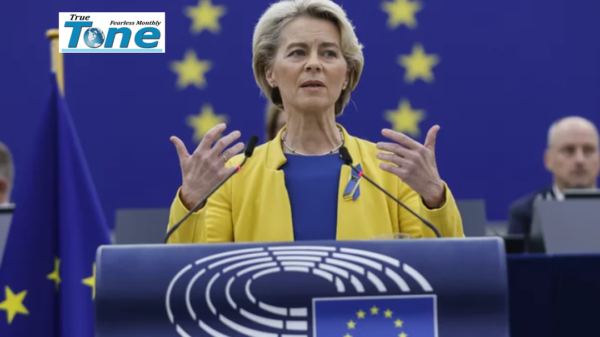
European Commission President Ursula von der Leyen is heading to Greenland in a visit that carries far greater geopolitical weight than a routine diplomatic trip. Her two-day journey to the vast Arctic territory is designed to reaffirm Europe’s political and economic commitment to Greenland at a moment when the island has become a focal point in the intensifying strategic rivalry between Europe and the United States.
Von der Leyen is scheduled to sign a joint declaration between the European Union and Greenland on Monday, underscoring Brussels’ determination to deepen its relationship with the Danish autonomous territory. The visit also sends a message to Washington: Greenland may be geographically remote, but Europe does not regard its future as a matter to be decided elsewhere.
Greenland’s importance is difficult to overstate. Sitting between North America and Europe and dominating a strategically crucial part of the Arctic, the island is increasingly viewed as a gateway to the region. Its enormous territory, proximity to emerging Arctic shipping routes, potential mineral wealth and importance to regional security have transformed Greenland from a peripheral European concern into a major geopolitical asset.
“Greenland is becoming increasingly important to the EU,” Marc Jacobsen, a researcher at the Royal Danish Defence College, told AFP, pointing to its Arctic position, critical raw materials and security significance.
That strategic importance is precisely what has attracted the attention of US President Donald Trump.
Earlier this year, Trump repeatedly argued that the United States needed control of Greenland for national security reasons. Although he eventually ruled out forcibly annexing the island, his campaign for greater American control dramatically altered the political landscape surrounding Greenland and prompted European governments to close ranks behind Denmark and Greenland.
For Brussels, the answer has increasingly been investment rather than confrontation.
Von der Leyen promised in January that the EU would make “massive” investments in Greenland to strengthen Arctic security. Brussels has proposed increasing direct EU assistance to Greenland to €530 million under the bloc’s proposed 2028–2034 budget. The Financial Times has reported that von der Leyen could announce another €200 million in support during her visit.
The financial commitments are strategically significant. Greenland is not an EU member, despite being linked constitutionally to Denmark, which is. Yet Brussels clearly sees the island as part of Europe’s wider strategic environment.
The timing of von der Leyen’s visit is also impossible to ignore.
Her trip coincides with the launch of NATO’s Arctic Shield military exercise, involving troops from 10 countries. The exercise reflects a broader recognition within the Western alliance that the Arctic is no longer a frozen geopolitical backwater. Military activity, resource competition, climate change and emerging transportation routes are turning the region into an increasingly contested strategic space.
Mikaa Blugeon-Mered, a geopolitics researcher at the University of Quebec, described the timing as a “not insignificant coincidence.”
NATO has already increased its Arctic focus, launching the Arctic Sentry mission at the beginning of the year. Denmark, meanwhile, has moved to strengthen its military presence and investment in Greenland following sustained criticism from the Trump administration that Copenhagen had neglected Arctic security.
Yet Europe faces an obvious limitation. The EU cannot offer Greenland the kind of military security guarantee that NATO can provide.
What Brussels can offer, however, may prove equally important in the long term: money, infrastructure, political backing, trade opportunities and access to European markets.
“The EU cannot provide Greenland with a military security guarantee in the way NATO can,” Jacobsen said, but it can send a politically important message that Greenland “is not standing alone.”
That message matters because American pressure has not disappeared.
Although Trump has been less outspoken about Greenland since a May visit by his special envoy Jeff Landry, Greenlandic officials have continued receiving reminders that Washington has not abandoned its strategic interest in the island.
“We’ve been getting ‘postcards’ from Trump or those close to him about Greenland every month,” Blugeon-Mered said, noting that such messages demonstrate that Washington has not forgotten the territory.
Trump himself posted an image on Truth Social in May showing him looking over Greenland beneath the words “Hello, Greenland!”
Then, in August, reports about preparatory operations by a Texas-based oil company in eastern Greenland revived concerns over American commercial ambitions. The company holds licenses issued before Greenland imposed a 2021 moratorium on oil and gas exploration and extraction. Authorities have yet to authorize exploratory drilling, citing procedural issues, but the episode has highlighted the complicated intersection of commercial interests, environmental concerns and great-power competition.
Greenland’s own economic ambitions add another dimension.
The territory hopes to develop its mineral resources as part of its long-term effort to achieve greater economic independence from Denmark. Its reserves of potentially valuable critical minerals have attracted international attention at a time when Europe and other major economies are desperately seeking alternatives to concentrated supply chains.
Here, European and Greenlandic interests appear particularly compatible.
Greenland needs capital, infrastructure, technology and reliable markets to develop its mining sector. Europe, meanwhile, wants secure and diversified access to critical raw materials essential to advanced manufacturing, energy technologies and strategic industries.
Yet Greenland’s mineral wealth remains largely potential rather than productive reality.
More than 60 companies reportedly hold around 135 mining permits, but only two mines are currently operating. Turning geological promise into commercially viable production will require enormous investment, infrastructure and political stability.
The question now is whether the geopolitical spotlight on Greenland will finally change that equation.
Von der Leyen’s visit—her second to Greenland in two years—is intended to demonstrate that Europe’s interest is not temporary. She is expected to meet Greenland Prime Minister Jens-Frederik Nielsen, Danish Prime Minister Mette Frederiksen and representatives of Denmark’s other autonomous territory, the Faroe Islands.
The broader message is unmistakable.
Greenland is becoming a frontline of the 21st-century Arctic competition. Washington sees strategic security and resources. Europe sees an increasingly important part of its geopolitical neighborhood. Greenland sees an opportunity to attract investment while pursuing greater autonomy.
The challenge for Europe is to turn diplomatic declarations into meaningful economic partnerships without treating Greenland merely as a strategic chess piece.
For Greenland, the stakes are even higher. The island sits atop enormous potential wealth and occupies one of the world’s most strategically important locations. But realizing that potential will require carefully balancing its relationship with Denmark, its growing partnership with Europe and the persistent strategic ambitions of the United States.
The Arctic is warming. Its geopolitical temperature is rising even faster.
And Greenland, once regarded as the distant edge of the Western world, is rapidly moving toward the center of global power politics.









Md.Shahidur Rahman Tepa
Publisher & Editor
Mrs. Naznin Sultana - Associate Editor
Dr. Sariful Hoque Priom - Assistant Editor
Head Office: Tepa Complex 169/A, SS Nazrul Islam Sarani, Purana Paltan, Dhaka-1000, News and Commercial Office: 48 Bijoy Nagar (3rd Floor) Dhaka-1000,
E-mail: monthlytruetone@gmail.com
Leave a Reply