

India tests indigenous TARA glide weapon system in major boost to precision strike capability
- Update Time : Saturday, May 9, 2026
- 100 Time View
International Desk
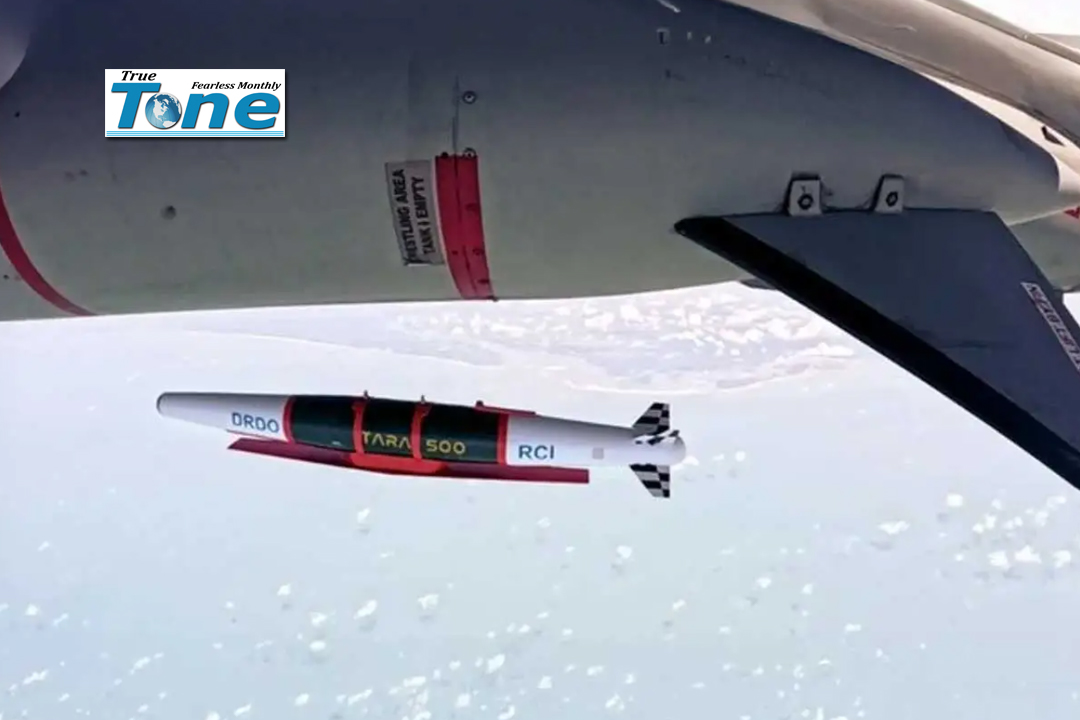
India has successfully conducted the maiden flight trial of its indigenous Tactical Advanced Range Augmentation (TARA) glide weapon system, marking another significant milestone in the country’s efforts to modernize its military capabilities and strengthen self-reliance in defense technology. The test, carried out jointly by the Defense Research and Development Organization (DRDO) and the Indian Air Force (IAF), demonstrates India’s growing expertise in precision-guided munitions and long-range strike systems.
The trial took place off the coast of Odisha on May 7 and was described by Indian defense officials as a major success. Developed primarily by the Research Center Imarat (RCI) in Hyderabad along with several other DRDO laboratories, the TARA extension kit is designed to convert conventional unguided bombs into high-precision glide weapons capable of striking ground targets with significantly improved accuracy.
The development is particularly important because it allows existing stockpiles of unguided bombs to be upgraded into advanced precision-guided munitions at a relatively low cost. This approach mirrors a broader global trend in modern warfare, where militaries increasingly rely on guidance kits attached to standard bombs rather than producing entirely new missile systems for every operational requirement.
According to the DRDO, the TARA kit enhances both the lethality and operational range of conventional warheads. Once attached to a standard aerial bomb, the system enables the munition to glide toward its target after being released by an aircraft. This capability allows fighter jets to engage enemy targets from safer stand-off distances, reducing exposure to hostile air defense systems.
The Indian defense establishment stated that production of the TARA kits for the armed forces has already commenced, indicating that the project has moved beyond the experimental stage and is entering operational deployment. The rapid transition from testing to production also reflects India’s growing emphasis on accelerating indigenous defense manufacturing under the “Atmanirbhar Bharat” or self-reliant India initiative.
Military analysts note that precision-guided glide bombs have become one of the most influential tactical innovations in contemporary warfare. Unlike expensive cruise missiles, glide bomb kits are comparatively affordable and can be mass-produced more easily. Their operational flexibility makes them valuable in both conventional conflicts and limited precision strike operations.
The TARA system is expected to improve India’s ability to conduct accurate strikes against fortified positions, infrastructure, logistics hubs, and battlefield targets without requiring aircraft to enter heavily defended airspace. Such systems are especially relevant in a region where air defense capabilities are rapidly evolving and military planners increasingly prioritize stand-off strike options.
India is not alone in pursuing such technologies. Several major military powers already operate similar systems. The United States has long employed Joint Direct Attack Munition (JDAM) kits, which transform standard gravity bombs into precision-guided weapons using GPS and inertial navigation systems. Russia has also expanded its use of glide bomb technologies during the Ukraine conflict, reportedly deploying upgraded systems capable of striking targets from distances exceeding 100 kilometers.
Reports last year indicated that Russian forces may have tested an advanced glide bomb kit known as the UMPB D-30SN, with a possible strike range of up to 150 kilometers. These systems have attracted significant attention due to their effectiveness in stand-off bombardment roles and their comparatively low production costs relative to guided missiles.
Israel is another country widely recognized for its expertise in precision-guided bomb kits. The Israeli Air Force has extensively used the SPICE (Smart, Precise Impact, Cost-Effective) guidance kit, which converts unguided bombs into advanced precision weapons. The SPICE system integrates electro-optical guidance, GPS navigation, and target recognition capabilities, enabling highly accurate strikes in complex operational environments.
India itself has shown growing interest in such systems. In December, India’s Defense Acquisition Council, chaired by Defense Minister Rajnath Singh, approved defense procurement deals worth approximately $8.7 billion. Indian media reports indicated that the package included procurement plans for Israeli SPICE kits as part of broader efforts to enhance the precision strike capabilities of the Indian Air Force.
The emergence of TARA could eventually reduce India’s dependence on foreign suppliers in this critical defense sector. Indigenous production offers several strategic advantages, including lower procurement costs, improved supply chain security, and the ability to customize systems according to India’s operational requirements. It also minimizes vulnerability to international sanctions or export restrictions that can affect access to advanced military technology.
Defense experts believe that TARA may also become an export opportunity for India in the future. Many developing nations seek affordable precision-guided weapon solutions but often face financial or political barriers when purchasing Western systems. A cost-effective Indian-made glide kit could potentially attract interest from countries looking to modernize their air forces without investing in expensive missile inventories.
The successful TARA test also highlights the increasing sophistication of India’s domestic defense research infrastructure. Over the past decade, DRDO has accelerated work on missiles, drones, radar systems, electronic warfare platforms, and advanced air-launched weapons. India has already demonstrated significant progress in indigenous missile programs such as the BrahMos supersonic cruise missile, the Astra air-to-air missile, and various ballistic missile systems.
At the same time, India continues balancing indigenous development with international defense partnerships. The country maintains defense cooperation with Russia, Israel, France, and the United States while simultaneously investing heavily in domestic production capabilities. The TARA project reflects this broader strategy of combining foreign operational lessons with homegrown technological development.
The growing importance of precision-guided glide bombs has also been reinforced by recent conflicts around the world. Modern battlefields increasingly reward systems capable of delivering accurate strikes from long distances while minimizing risks to pilots and aircraft. Glide bomb kits provide an efficient middle ground between traditional gravity bombs and high-cost missile systems.
For India, the TARA program represents more than just another weapons project. It symbolizes the country’s ambition to emerge as a technologically advanced military power capable of designing, producing, and deploying sophisticated combat systems independently. As geopolitical tensions continue to shape security dynamics across Asia and beyond, the ability to rapidly field indigenous precision strike capabilities could become an increasingly important component of India’s strategic posture.
With production already underway and successful testing completed, TARA is likely to become an important addition to the Indian Air Force’s expanding arsenal of smart munitions. The program underscores India’s determination to strengthen its defense-industrial base while adapting to the changing realities of modern warfare.



















Md.Shahidur Rahman Tepa
Publisher & Editor
Mrs. Naznin Sultana - Associate Editor
Dr. Sariful Hoque Priom - Assistant Editor
Head Office: Tepa Complex 169/A, SS Nazrul Islam Sarani, Purana Paltan, Dhaka-1000, News and Commercial Office: 48 Bijoy Nagar (3rd Floor) Dhaka-1000,
E-mail: monthlytruetone@gmail.com
Leave a Reply